

Aug 10, 2026
Market Roundup
-
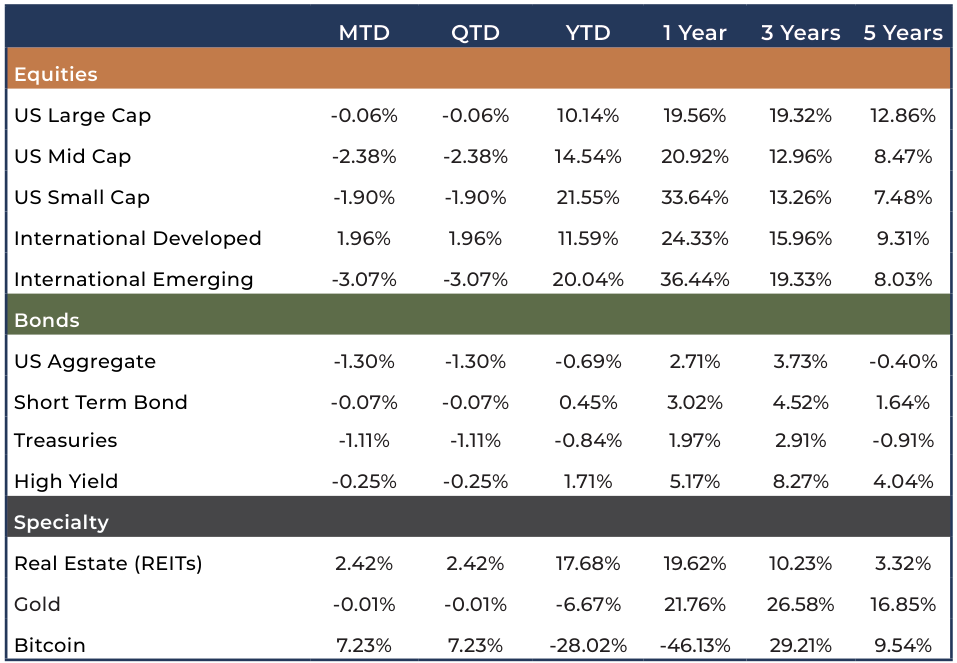
Equity leadership broadened but remained uneven: U.S. large caps were essentially flat in July, mid and small caps declined, while developed international equities and REITs led; Bitcoin rebounded 7.23% after a difficult first half.
-
The Fed held rates at 3.50%-3.75%, but three dissents for a hike and Chair Warsh’s inflation-first message kept pressure on longer-duration bonds and pushed rates volatility back to the center of market attention.
-
Oil and geopolitics re-emerged as inflation risks. Renewed Middle East tension lifted Brent above $100 and gasoline prices moved higher, offsetting part of June’s relief and weighing on the inflation outlook.
-
AI remained the dominant earnings theme, but investors became more selective, rewarding durable revenue and margin visibility while questioning heavy capex plans and delayed monetization timelines.
-
Tariffs and global policy uncertainty added another headwind as new U.S. import levies, a weak yen, and upcoming China policy decisions complicated the outlook for margins, inflation, and global demand.
Source: Bloomberg, L.P.
Positioning & Outlook
- The September Fed meeting is the next major policy checkpoint, with two jobs reports, two inflation prints, and Jackson Hole likely to shape whether markets price another hike or a longer hold.
- Energy prices remain a key swing factor. A sustained easing in oil would help inflation and consumers, while another Middle East escalation could pressure bonds, equities, and risk appetite.
- Earnings quality should matter more than headline growth. Markets may continue to favor companies showing tangible AI returns, strong free cash flow, and pricing power.
- Trade policy, China PMI data, and the November tariff truce deadline could move international equities, emerging markets, industrials, and companies with import-sensitive margins.
- For the balance of 2026, diversification remains important: high-quality short-term bonds, real assets, international exposure, and select private markets can help offset valuation and rate risk.
Disclosures
Important Information
Advisory services are provided by Bison Wealth, LLC (“Bison”) an investment adviser registered with the SEC. Registration does not imply a certain level of skill or training. The information contained herein is for informational purposes only, is believed to be reliable, has not been independently verified and is based on the opinions of Bison and subject to change at any time without notice. Nothing herein should be deemed an offer or solicitation to buy or sell a security or to provide investment advice. All investments contain risks to include the total loss of invested amounts. Past performance is not indicative of future results. Diversification does not protect against losses.
Index Disclosure
An index typically measures the performance of a basket of securities intended to replicate a certain area of the market, asset class or geopolitical region among others. Indices do not represent investments in actual accounts. Investors cannot invest directly in an index. The asset classes noted here reflect the following indices: “U.S. Large Cap” represented by the S&P 500 Index. “US Mid Cap “represented by the S&P 400 Index “U.S. Small Cap” represented by the S&P 600 Index. “International” represented by the MSCI Europe, Australasia, Far East (EAFE) Net Return Index. “Emerging” represented by the MSCI Emerging Markets Net Return Index. “U.S. Aggregate” represented by the Bloomberg U.S. Aggregate Bond Index. “Treasuries” represented by the Bloomberg U.S. Treasury Bond Index. “Short Term Bond” represented by the Bloomberg 1-5 year gov/ credit Index. “U.S. High Yield” represented by the Bloomberg U.S. Corporate High Yield Index. “Real Estate” represented by the Dow Jones REIT Index. “Gold” represented by the LBMA Gold Price Index. “Bitcoin” represented by the Bitcoin Galaxy Index.